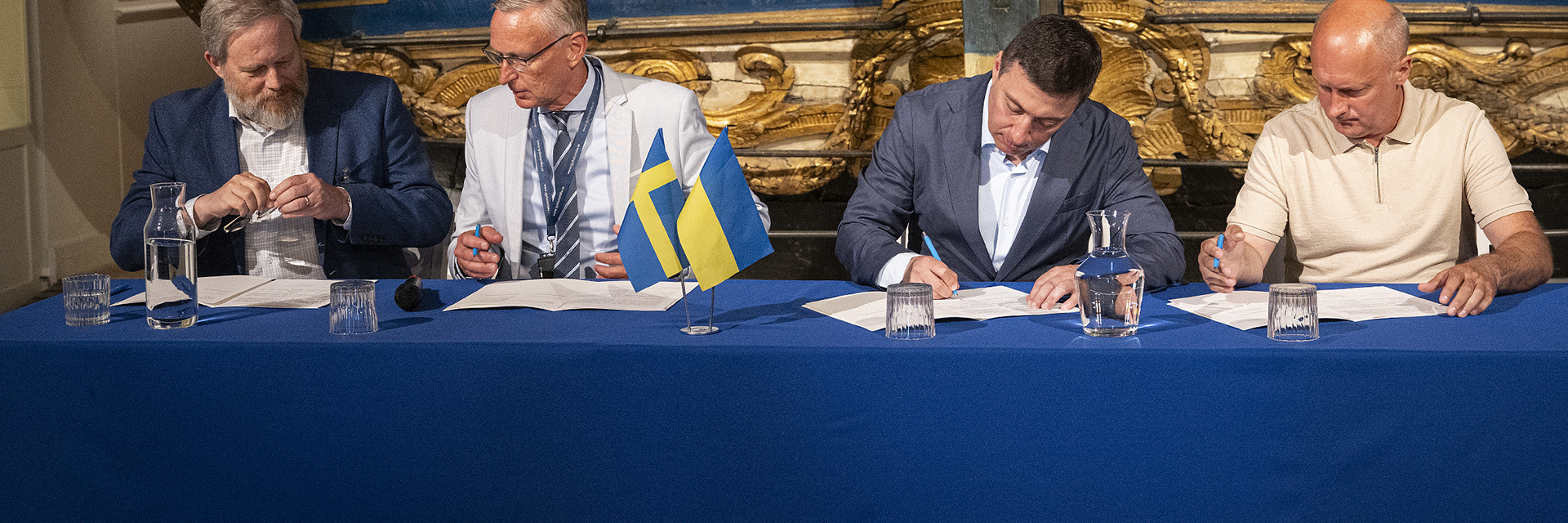
New collaboration to protect cultural heritage during war
Cultural heritage is not only about the past. It is about identity, knowledge, and people’s ability to understand their history and build their future. When cultural heritage is destroyed in war, far more than buildings and objects are lost.
This is the foundation of the new international collaboration now being established between Sweden and Ukraine.
On 29 June, the National Maritime, Transport and Defence Museums (SMMTF), together with Ukrainian authorities, cultural heritage institutions and the International Congress of Maritime Museums (ICMM), signed a Memorandum of Understanding to establish an international centre for research, documentation and preservation of cultural heritage in Velykyi Luh in southern Ukraine.
The centre will strengthen Ukraine’s capacity to document, investigate and preserve cultural heritage that has been damaged or is threatened by Russia’s full-scale invasion. The initiative is about both developing knowledge today and building the expertise needed when the country’s reconstruction begins.
As part of the collaboration, SMMTF will also receive and temporarily safeguard Ukrainian cultural objects at risk of destruction during the war. The objects will be returned to Ukraine when conditions allow.
“Not since the Second World War has Sweden participated in such a comprehensive effort to protect another country’s cultural heritage,” says Mats Djurberg, Director of the Maritime Museum, part of the National Maritime, Transport and Defence Museums.
Swedish expertise contributes to Ukraine’s cultural heritage work
SMMTF has collaborated with the Khortytsia National Reserve in Zaporizhzhia since 2022. Despite the war, Ukrainian archaeologists have continued their work to document and protect cultural heritage, while Swedish experts have contributed knowledge in maritime archaeology, conservation and museum management.
One example is the joint excavation in 2025 of an almost 300-year-old shipwreck, which became visible after the destruction of the Kakhovka Dam caused water levels to fall dramatically.
The destruction of the dam had major humanitarian and ecological consequences, but it also revealed thousands of previously hidden archaeological remains in the Velykyi Luh area. While new opportunities for research emerged, the cultural heritage also became more vulnerable to damage and looting.
The new centre will coordinate research, train archaeologists and conservators, and create long-term conditions for documenting and preserving these unique cultural environments.
“The centre will provide important support in building Ukraine’s capacity to address, in various ways, the enormous damage that the war has caused to the country’s cultural heritage,” says Fred Hocker, Research Director at the Vasa Museum and Chair of the Executive Committee for Archaeology within ICMM.
Cultural heritage as a part of resilience
The commitment to Ukraine is deeply rooted at Royal Djurgården. Through a unique sustainability collaboration, Royal Djurgården’s museums, cultural institutions and attractions work together to advance sustainable development, share knowledge and address common challenges.
Already in spring 2022, several of Djurgården’s institutions took initiatives to support both the Ukrainian people and the country’s cultural heritage. The Nordic Museum launched a fundraising campaign to support threatened cultural heritage in Ukraine, Djurgården’s cultural institutions and attractions jointly created an activity centre for Ukrainian children who had fled the war, and Spiritmuseum highlighted the stories of Ukrainian winemakers continuing their work during the war through the photo exhibition Brave Wine.
SMMTF’s new collaboration is a natural continuation of this commitment. Together, Djurgården’s cultural institutions demonstrate how knowledge, culture and international cooperation can help protect people’s history, identity and future.
The work contributes to several of the United Nations Sustainable Development Goals and demonstrates how cultural heritage is an important part of sustainable and resilient societies. Protecting cultural heritage during armed conflict is an investment in a sustainable future. Knowledge, culture and identity are vital resources when a country rebuilds after war.

Protects and preserves cultural heritage as part of sustainable societies.

Strengthens cultural institutions and preserves shared heritage during conflict.

Builds long-term international partnerships between museums, researchers and authorities.
