Together for better cycling
At Djurgården, we collaborate around sustainability. Transport is one of our most important issues, and cycling is a natural part of a more sustainable city. Cycling to and around Djurgården is not only climate-friendly – it is also a wonderful way to experience parks, museums and cultural landscapes at a slower pace.
But for more people to choose the bicycle, the route here needs to work well. And that journey starts long before reaching Djurgårdsbron. That is why cycling to Djurgården is not only a matter for Djurgården itself – it is a matter for the whole city.
During 2025, the Royal Djurgården Society, together with the Royal Djurgården Administration, the City of Stockholm and the Swedish Cyclists’ Association (Cykelfrämjandet), carried out a cycle route analysis within the EU project Scale Stockholm – Mobilising for Climate and Health. The aim was to better understand how the cycling routes to Djurgården function in practice – and how they can be improved.
Strong engagement from cyclists
The work began by engaging cyclists to test an important route to Djurgården themselves. Participants cycled the route Slussen – Evenemangsparken – Rosendal – Museiparken – Royal Djurgården Visitor Center and shared their experiences along the way.
The response was strong. Many people chose to take part – not least from Djurgården’s own organisations and attractions. This clearly shows the strong commitment to sustainable transport among the stakeholders on Djurgården.
The cyclists’ observations were collected and then used as the basis for the next step in the process.
A cycling workshop along the route
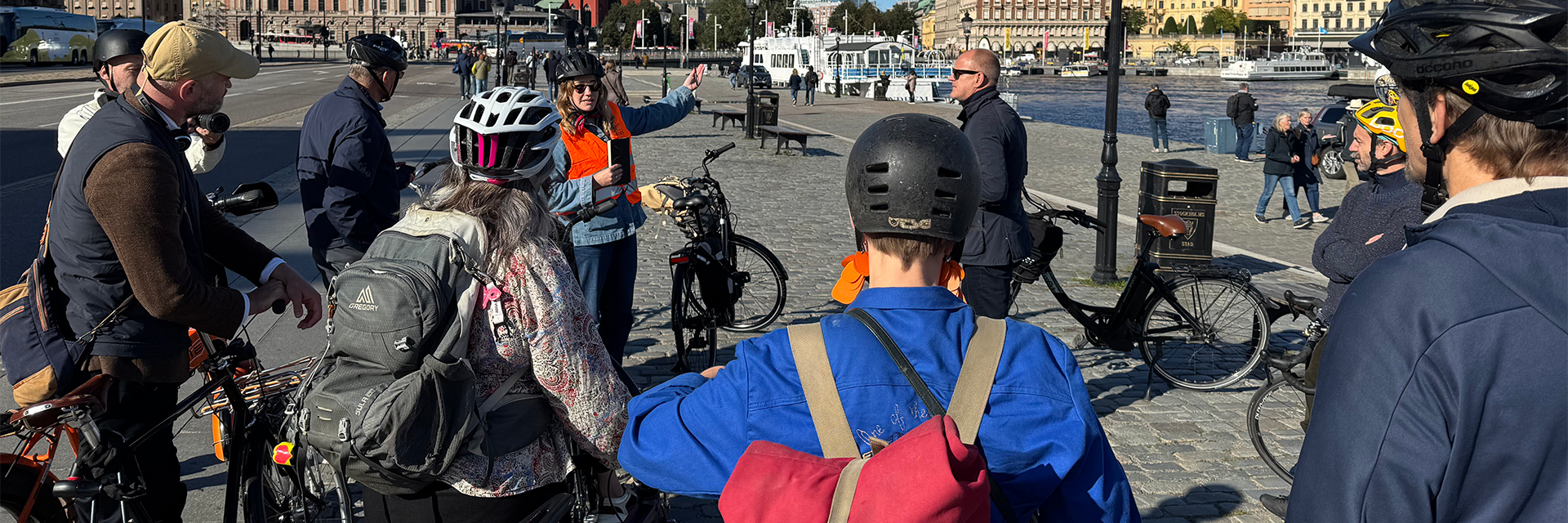
On 23 September 2025, representatives from organisations, the city and political parties gathered for a cycling workshop along the route. During the ride, the group stopped at several locations to discuss the observations raised by the cyclists.
Cycling the route together created a concrete conversation about how the infrastructure works in reality – and why certain situations arise. It also opened the door to discussions about possible improvements.
Participants included representatives from the Swedish Cyclists’ Association, the Royal Djurgården Society, the Royal Djurgården Administration and the City of Stockholm, as well as politicians from several parties.
Good conditions – but also room for improvement
The analysis shows that there are good conditions for cycling to and around Djurgården, but also clear opportunities for improvement.
On many stretches, pedestrians and cyclists are separated, which creates a safer environment. At the same time, cyclists pointed out that:
- some passages are perceived as narrow
- intersections, for example at Djurgårdsbron, can be unclear and feel unsafe
- signage along parts of the route could be improved
The assessments in the analysis are qualitative and based on how cyclists experience the route rather than on exact measurements. The aim is to capture how the infrastructure works for those of us who cycle here.
Cycling is important for Djurgården’s future
Djurgården welcomes more than 15 million visitors every year. How people travel here affects the climate, accessibility and the overall experience of the area.
That is why well-functioning cycle routes are an important part of Djurgården’s work with sustainable transport. At the same time, we know that the conditions for cycling are shaped across the entire city – from central hubs such as Slussen and all the way out to Djurgården.
Through the collaboration within Scale Stockholm and the ongoing dialogue with the city, cyclists’ experiences can contribute to improvements over time.
The goal is simple: to make it safe, clear and attractive to cycle to and around Djurgården.
When more people can choose the bicycle, Djurgården becomes both more accessible and more sustainable – and an even better place to visit, work and experience.
A warm thank you to the Swedish Cyclists’ Association, the City of Stockholm and the Royal Djurgården Administration for an excellent collaboration. We now look forward to the final report.

The cycle route analysis can contribute to the development of a better cycling infrastructure and sustainable transport in the city. By making it safer and easier to cycle to Djurgården, the project contributes to a more accessible and sustainable urban environment. (11.6)

By promoting cycling, the cycle route analysis contributes to reduced emissions from car transport. By getting more people to choose the bicycle instead of the car, the work helps to reduce the city’s climate impact. (13.2)
