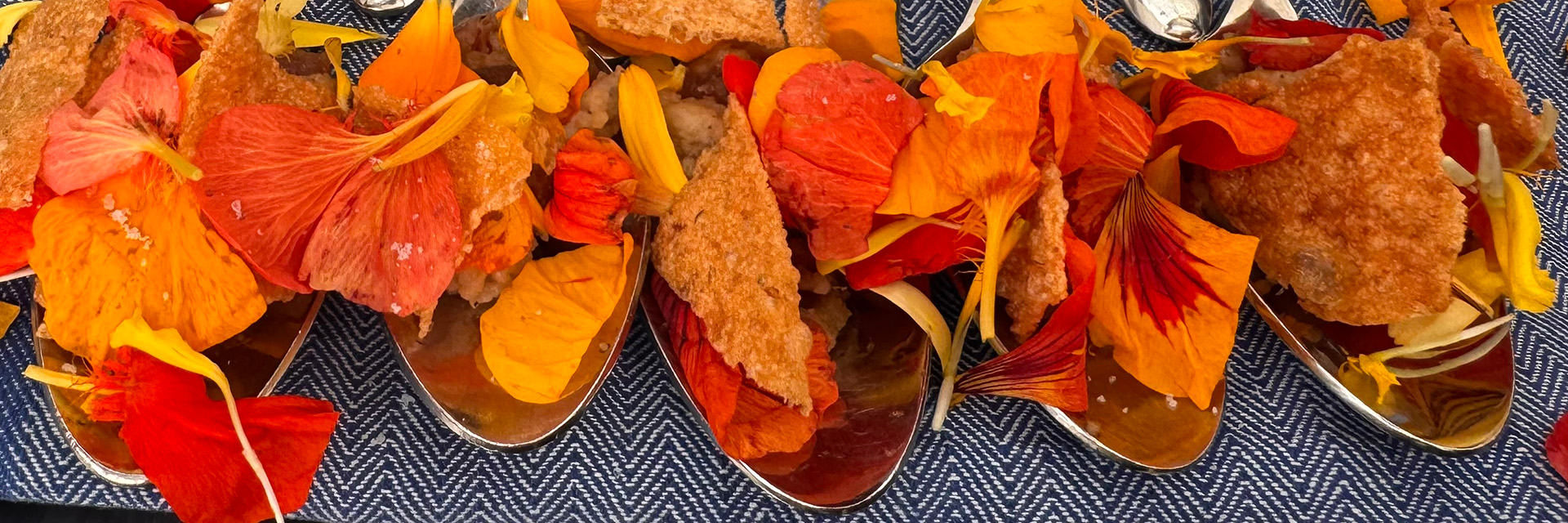
A Lesson in Zero Waste at Rosendals Trädgård
What a wonderful day. Restaurants across Kungliga Djurgården marked the UN’s International Day of Awareness of Food Loss and Waste by serving waste-smart dishes and handing out the new booklet A taste of Sustanable Djurgården!. In the booklet our restaurants share recipes, tips and their own experiences of working against food waste. The same day, Sweden Foodtech held its Big Meet at Rosendals Trädgård, and here too, inspiration was on the menu. Douglas McMaster, chef and founder of Silo, the world’s first zero-waste restaurant, who has run food systems with no general waste bin at all for over a decade and now builds similar projects around the world, took the stage with a talk that felt less like a lecture and more like an awakening: There Is No Bin in the Jungle.
His thinking fit naturally with the message on Djurgården. While our kitchens shared practical tips on turning potato mash into potato cakes or fish trimmings into Wallenbergare, McMaster offered something that completed the picture: a philosophy for why we create waste in the first place, and what it would mean to design a food system that simply doesn’t. Three questions ran through the talk like a red thread: What is waste? Why did it appear? And how do we remove it? What makes his thinking so powerful is his creativity and his refusal of inherited thinking. As he put it: “There’s a lot of problems in the world and we can’t improve upon those problems if we use the same thinking that created those problems.”
Good Bins, Bad Bins, and the Restaurant Built to Have Neither
McMaster distinguished between a “good bin” (compost — he prefers to call it a “compost silo,” since nothing turning into soil is truly dead), an “okay bin” (recycling, good in principle but poorly executed in most systems), and a “bad bin” — general waste, which he called “a coffin. That’s where materials go to die.”
This thinking led to the restaurant Silo, born from a question by an artist friend in Sydney: “Could you give up having a bin altogether?” The challenge became a way of life. The restaurant’s dining room ran on a projected menu instead of paper, vegetables arrived in reusable crates cycling endlessly through the supply chain, and cleaning products were refilled rather than delivered in endless packaging.
Turning Scraps into Syrup, and Waste into Miso
Much of what he said connected to the day’s food-waste spirit on Djurgården, and to the power of creativity. McMaster described boiling down mountains of vegetable scraps — the kind sitting in everyone’s fridge drawer — into a savoury “treacle vegetable syrup,” so popular the kitchen could never keep up with demand. Then came koji, the fungus behind miso, soy sauce and fish sauce: at Silo it became the answer for materials with no other way back into the system — crab shells, egg whites, shiitake trimmings, rice bran, blueberry skins, venison and mackerel trimmings, even rabbit carcasses. Nearly two tons of koji-based fermentation ran through the kitchen at its peak.
One elegant example: a dessert built entirely from byproducts — buttermilk from making butter became a dulce de leche ice cream, bran from milling flour became a wafer, surplus bread became a syrup — closing the loop from the start of the menu to its very end.
When Nothing Is Waste
The zero-waste philosophy extended well beyond food. Soft plastics that inevitably entered the restaurant were turned into platters by a collaborating artist, and nitrous oxide canisters — a common sight discarded on London streets — became knife handles. As McMaster put it, “if there was ever a time to say waste is a failure of the imagination, it’s with this knife.”
Wine bottles, the one unavoidable single-use item in the system, were crushed into glass powder and refired into tableware, tiles and plates; corks became “corking stocks.” After more than a decade without a general waste bin, Silo’s actual residual waste now amounts to almost nothing.
His conclusion distilled the entire talk into one insight: “What is waste? It’s a symptom of our unsustainability, our lack of nature… As designers we ask, what does nature want? We go back to the jungle.” And the answer to the title itself: “In nature, there is no waste. There is no bin in the jungle.”
Asked what single factor would spread this thinking into more restaurants and more homes, McMaster didn’t hesitate: “Teach kids. Teach kids about nature… Get them in nature. Teach them about growing food, cooking food, soil systems, ecosystems, balance.” His belief is disarmingly simple — that balance, once understood early, tends to find itself.
From the Jungle to Djurgården’s Kitchens
It felt fitting that McMaster’s talk landed the very same day our own restaurants put their food waste work on the menu. His message and our local initiative speak the same language, each in its own way.
Over 2024–2026, more than a dozen restaurants on Djurgården have taken part in the project “Circular and Resource-efficient,” measuring and analysing their food waste with tools from Generation Waste. Restaurants that measured regularly cut their food waste by up to 36 percent on average — a concrete result showing that the same principle McMaster champions, that nothing needs to go to waste if a system is designed with more care, also works in practice, day to day, in ordinary kitchens.
Twelve venues across Djurgården — Backstage Hotel, Junibacken, Mackverket Vrak, Nordiska museets restaurang together with Restaurang Eld, Rosendals Trädgård, Sjöhistoriska Café och Bar, Skansen-Akvariet, Spritmuseum, Tekniska museets restaurang, Vasamuseets restaurang, Restaurang Djurgårdsbron and Waldemarsudde’s Prinsens kök — marked the day by serving waste-smart food and handing out the booklet, full of recipes and tips: potato mash into potato cakes, herb stalks into pesto, root vegetable peels into pangrattato, fish trimmings into Wallenbergare, and leftover buns given new life in cakes and desserts.
It reflects the same idea Douglas McMaster demonstrated on stage: what’s “left over” is raw material, not rubbish — and something genuinely delicious can emerge from it. As McMaster said, closing his talk: “Because if nature wastes nothing, then why should we?”
Thank you, Sweden Foodtech, for an inspiring day, Stockholm Business Region for Stockholm ImpACT Days, and all my colleagues across Djurgården for your deep commitment.
/Camilla Zedendahl

PROJECT FACTS
Project on food waste on Djurgården: PROMOTING CIRCULAR AND RESOURCE-EFFICIENT PRACTICES – through a shared approach and in how we engage with our guests
Project owner: Kungliga Djurgårdens Intressenter
Participants: Restaurants and attractions on Djurgården
Project period: 2024–2026
The project is 40% funded by the European Regional Development Fund.
